Sauce First, Opinions Always: New Hampshire Can't Stop Fighting About Wings
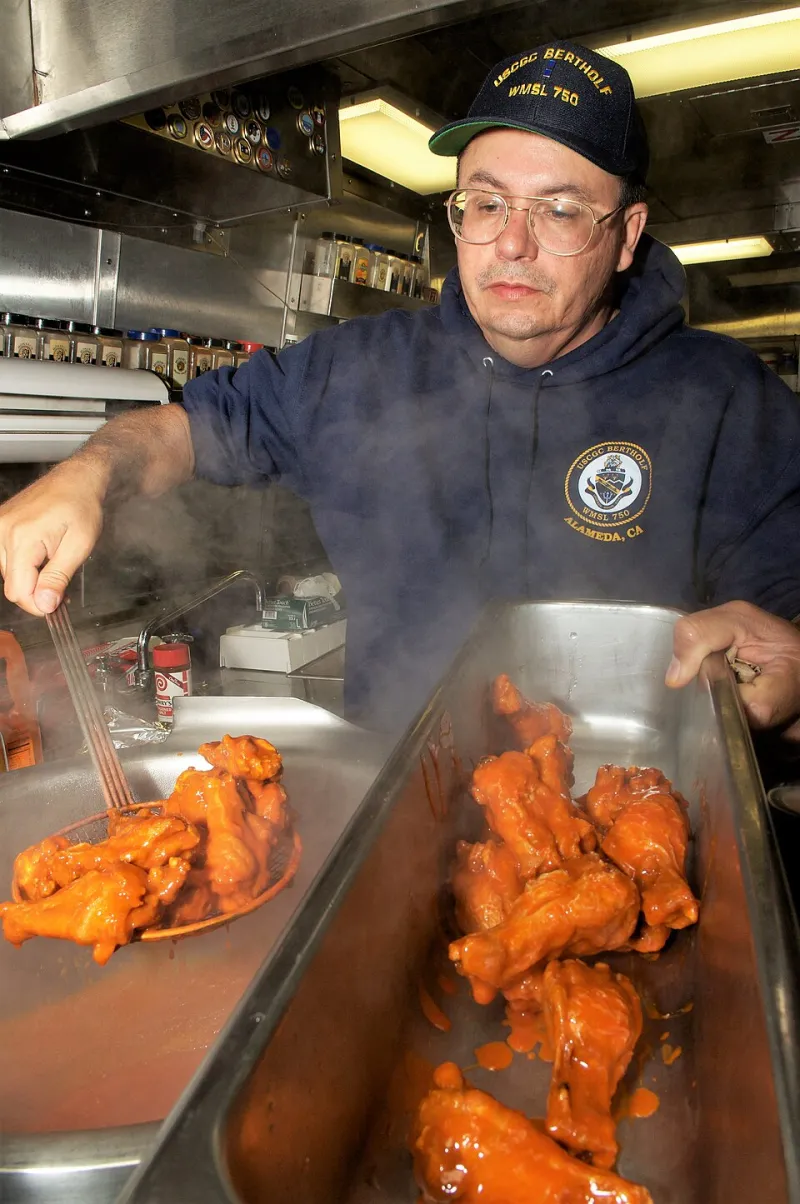
Photo: Coast Guard photo/ Petty Officer 2nd Class Jetta H. Disco, Public domain, via Wikimedia Commons
There's a moment that happens in nearly every New Hampshire bar between October and March. A basket of wings hits the table, someone at the next stool leans over, and before the first one is even picked up, a verdict is delivered: those are baked, right?
It's not a compliment. Or it is. Depends entirely on which side of the line you were born on.
Here in the Granite State, the wing is not a bar snack. It's a proxy war. And the battle lines — sauce-soaked and oven-crisped on one side, deep-fried and dry-tossed on the other — run right through the middle of the state, splitting families, Sunday watch parties, and at least one marriage I know of in Rochester.
The Baked Camp: Where the Sauce Is the Point
Ask around the roadhouses north of the Notches and you'll hear the same logic, repeated like catechism: a wing is a delivery vehicle. The skin should be lacquered, not shattered. The sauce should soak in, not sit on top like a raincoat.
The baked-wing method is gloriously low-tech. Wings go into the oven, often on a sheet pan older than the cook, and come out with skin that's rendered but yielding. Then — and this is the part fried purists can't abide — they get drowned. Melted butter, hot sauce, a whisper of honey or maple in the better kitchens. The wings rest in it. Some places sauce them twice, once mid-bake and once after, building up a glaze that clings like a winter coat.
What you lose in crunch, the argument goes, you gain in flavor. Every bite carries sauce all the way through. There's no dry interior hiding behind a crispy shell. It's a wing you eat with a fork if you're fancy and with three napkins if you're honest.
"My grandmother did them in the oven," a bartender in Berlin told me, shrugging like that settled it. In a lot of these towns, it does.
The Fried Camp: Crunch Is a Moral Position
Cross into the Merrimack Valley and the tone changes. In Manchester barrooms and Nashua sports pubs, the fried wing is treated less like food and more like a standard of civilization.
The orthodoxy here is simple: skin is meant to shatter. Oil at the right temperature, a double fry if the kitchen takes pride in itself, and sauce applied at the last second — tossed, never soaked — so the coating stays intact. The sauce is a seasoning. The wing is the star.
Fried partisans will eat a baked wing, technically. But they'll spend the whole plate narrating their disappointment. "Soggy," "steamed," "basically a chicken popsicle" — I heard all three in one afternoon. There's a genuine grief in it. These are people who believe texture is flavor, and every limp wing is a small betrayal.
The best of the fried camp — and there are some excellent ones scattered from Derry to Dover — understand restraint. Sauce hot enough to tingle, butter enough to round it out, and wings that stay audibly crisp even after the toss. Done right, it's undeniable. Even a baked loyalist will go quiet for a minute, chewing.
How a Bar Plate Became a Blood Feud
Nobody I talked to could point to the origin of the divide, which is how you know it's old. The most plausible theory is economics. New Hampshire is a working state, and ovens are cheaper than fryers — less oil, less grease disposal, less fire risk in a small tavern with one person behind the bar. Baked wings made sense for a roadhouse running a kitchen the size of a closet. The method stuck, got defended, got inherited.
Fried wings, meanwhile, arrived with the sports-bar wave of the '80s and '90s and never left the bigger cities. So the geography roughly maps: baked country up north and in the small towns, fried country in the urban corridor. Naturally, everybody's cousin muddies the map.
And then there's hockey. Wing season in New Hampshire isn't really about the calendar — it's about the rink schedule. Youth hockey tournaments, Bruins games, the long stretch between foliage and mud season when there's nothing to do but sit somewhere warm and argue. That's when the plate counts double.
The Truce Plate (It Exists)
Here's my confession after a week of fieldwork: the argument is more fun than either answer.
But if you're hosting and need peace, do what a couple of smart kitchens around Concord and Laconia have quietly figured out. Bake low and slow to render the fat, then finish in a screaming-hot oven or a blast of oil just before serving. Sauce them tossed, not drowned. You get crunch and saturation, and both camps at the table can claim victory.
Serve them with blue cheese from a local creamery, celery you actually washed, and a cold local lager. Keep the paper towels within arm's reach.
The fight will continue, of course. It should. Some arguments are how a state keeps itself company through winter. But now, at least, you'll know which side of the plate you're standing on.
Where do you land — baked or fried? The comment section is open, and yes, it will get heated.